


“I know I have talked about this somewhere already.”
I caught myself thinking that more and more while working on ArtMakers, a project I’ve been building for several years.
The problem was usually what came next: where ist it?

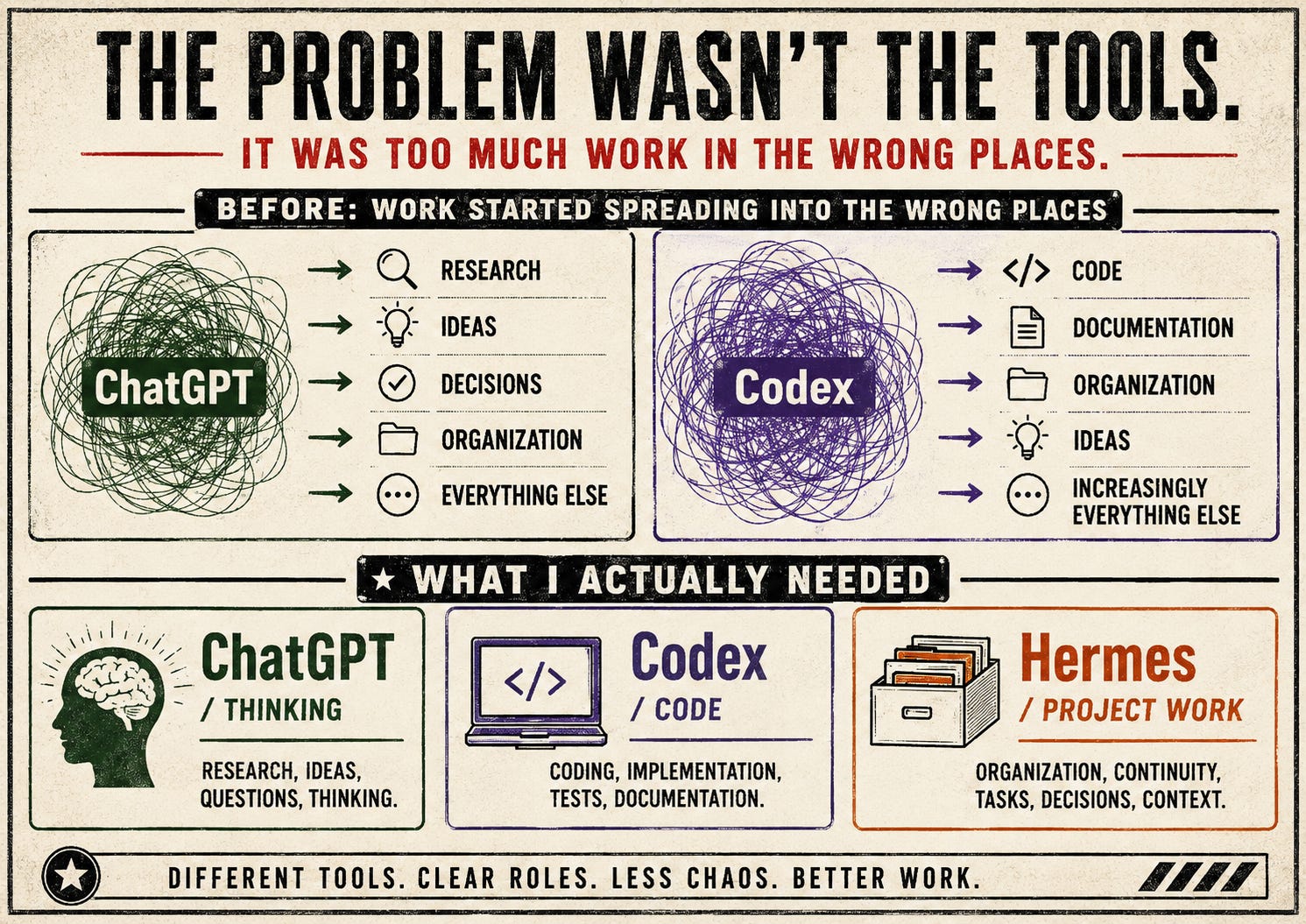
I’m using ChatGPT for research, ideas, technical questions, decisions and whatever else comes up around the project. Starting another chat was easy, so that’s what I did.
Within a few days/weeks, there were hundreds of them.
I knew useful information was sitting somewhere in the history. I just couldn’t find it when I needed it the most. A decision I once made might be buried in a conversation from months ago. An idea I wanted to revisit is probably somewhere behind a chat-title that no longer connects to the idea the conversation headed to.
The AI was helping me coming forward with lot of work. Keeping track of the work I had done with AI was becoming a separate problem. A big one, to be fair.
And opening another chat clearly wasn’t going to solve it.
The problem pursued me
Codex improved a different part of the way I worked.
For coding, it made much more sense to use an AI with abilities that could work around the actual project instead of explaining the codebase again inside a normal chat.
So I used it more and more.
Then other things slowly found their way in.
Documentation. Project organization. Administrative tasks. Ideas that occurred while I happened to be working there.
Codex could handle those things very well. That wasn’t really the issue.
I just didn’t want my coding environment to slowly become the place where I ran the rest of the project too.
In hindsight, that sounds fairly obvious. It wasn’t something I had thought much about before.
My way of choosing AI tools had mostly been based on capability. If a tool could do something, why not use it, right?!
Now I was starting to care about something else.
Where should this kind of work actually live?
I had moved some of my work out of ChatGPT, only to begin recreating the same mess somewhere else. That was not as efficient as I hoped it would be before.
That was when Hermes started to make more sense to me.
I thought I’d have to build much more myself
Profiles were probably the first Hermes feature that really convinces me, to give it a try.
I kept discovering that things I assumed I’d have to learn and study myself were already there and working. Profiles could keep their own context. There was a Kanban system. Hermes already knew how to work with built-in plugins, skills, and memory.
I didn’t need to understand all of it before I could just start using it.
That part surprised me. Like, a lot!
From the outside, words like agents, memory, skills and orchestration can make those things sound like something you should understand properly before touching it.
And let me make this as clear as possible here: YOU DON’T!
Most of the time, I simply told Hermes what I was trying to achieve and asked for the available options. I learned what the different approaches as soon as I needed them.
There wasn’t a complex agent architecture at the beginning.
First, there was just one annoying problem.
I kept losing track of things.
So I let it create a librarian
My first important specialized profile wasn’t a developer or an autonomous project manager.
It was a librarian.
Its job was simple:
look through what I had been working on
help me keep track of it
and give me a clearer picture of what was still open.
I had it review my chats in the evening. Together with Hermes’ Kanban board, that gave me something I had been missing for a while: clearance and continuity.
The next day, I didn’t have to reconstruct quite as much from memory.
Ideas were less likely to disappear into an old chat. Open tasks had somewhere to go. I had a better sense of what deserved my attention next.
None of this felt particularly futuristic.
It was mostly just useful.
And once that worked, the rest became easier to think about.
I could create another profile when a different kind of work needed its own context. Coding could stay close to Codex. Organizational work could live somewhere else. I didn’t have to predict the finished system before building the first useful part of it.
There was a practical detail that made experimenting easier too.
Hermes itself is free and open source. In my setup, it can use my ChatGPT subscription I’m already paying for through its Codex integration rather than requiring another Hermes subscription. Hermes also ships with a skill for delegating coding work to the Claude Code CLI, which can use the allowance from an eligible Claude subscription when authenticated that way.
So trying this didn’t mean signing up for yet another monthly AI service before I even knew whether it would help.
That made it much easier to just try it and see whether it was useful.
The part I still don’t hand over completely
The system is more organized now. That doesn’t mean I let AI maintain every part of it on its own.
I learned to be careful with that fairly early.
At one point, information was being treated as something that could be removed because it hadn’t been needed for a while.
I understood the reasoning. I just didn’t agree with it.
An old note might contain an abandoned idea. But it might also contain the reason I abandoned it. Or something I deliberately postponed and want to return to six months later.
So one of the rules became very simple:
Never delete. Only archive.
Of course there are more rules now, and more profiles than that first librarian. Some of them need attention from time to time. I still change things when a setup starts creating more work than it removes.
But that’s not the part I wish somebody had explained to me earlier.
I wish I’d understood how little of the finished system I needed to know before I could start.
I didn’t begin with an agent architecture.
I began with a problem I was tired of having.
I couldn’t find things I had already worked on.
So I gave that problem somewhere to live.
With a librarian.